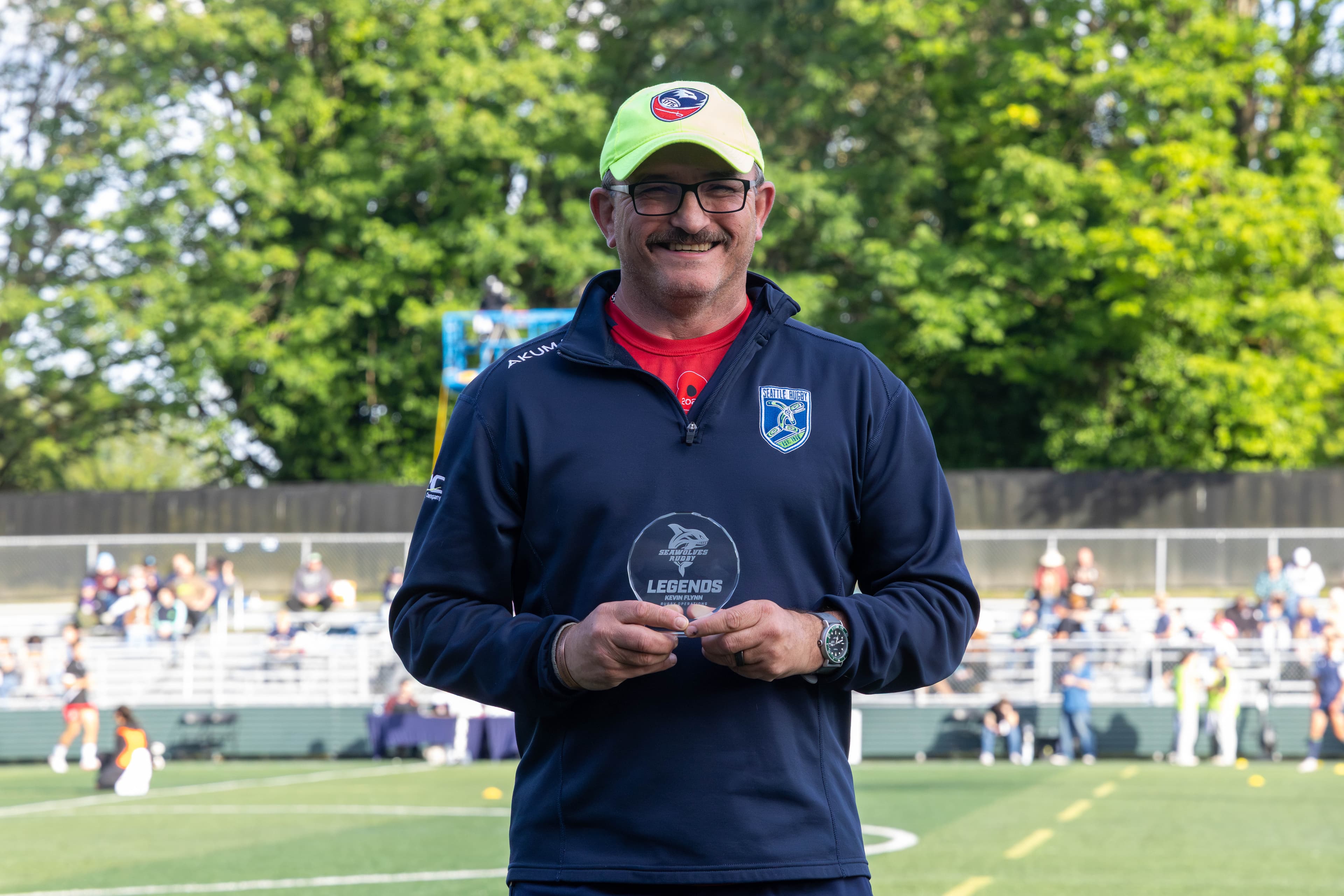
Kevin Flynn has a motto tattooed on his arm. It's on his email signature too, and on the jerseys and tracksuits of Seattle Rugby Club. Around kids, he calls it "the stuff people don't see." The real version is a little stronger than that.
TSPDS. Four words that mean something different to every person who encounters them — a professional athlete, a military veteran, a kid from a marginalized community, a parent trying to be better. The question it asks is always the same: what are you doing when nobody's watching?
It's a fitting motto for a man whose most important work has almost never been in the spotlight.
A founder of the Seattle Seawolves, president of Seattle Rugby Club, creator of the Rugby Works nonprofit, general manager of the USA Military rugby program, and one of the most consequential figures in Pacific Northwest rugby history, Flynn has spent decades doing the stuff people don't see — and quietly building something that has changed lives in ways most fans will never fully know.
From Ireland to Seattle, by Way of Everywhere
Flynn grew up in England with an Irish father, discovered rugby in school when it turned out that being too physical for soccer was actually an asset, and never looked back. He played at London Irish, one of England's well-regarded clubs, then followed the game across the world — Australia, back to the UK, then the United States. Seattle Rugby Club brought him over, and he went on to play in the Canadian Premiership and the US Super League before retiring around 42.
"Once I landed and started seeing the commitment it took to play up here, I thought: these guys must really love this game to do what they do," he says.
He stayed. The Pacific Northwest felt like home — the mountains, the weather, the community. And there was work to do.
After retiring from playing, Flynn took on the role of running Seattle Rugby Club and started a long process of self-reflection about what rugby had actually given him over the course of his career. What he found was that he had taken almost all of it for granted — the employment it opened doors to, the travel it enabled, the friendships it forged, the structure it provided at moments when he needed it most.
He decided to stop taking it for granted. And he decided to start telling the story differently.
A Founder, a Builder
When Major League Rugby was being formed in 2017, Flynn was in the room. Not as a money person — as a rugby person. Someone whose job was to make sure the sport stayed at the center of what was being built.
Seattle Rugby Club, founded in 1966, was already the foundation of elite rugby in the Pacific Northwest. Its logo featured a Native American orca. When the Seawolves were created as its professional descendant, that orca came with them. Flynn became the Seawolves' team manager from the club's founding in 2018, helping build many of the operational and cultural foundations of the organization in its early years.
He left for a period when the direction of the club gave him pause. He came back when head coach Allen Clarke arrived and the culture shifted toward something he recognized and believed in. That pattern — staying true to his values even when it meant stepping away — says as much about Flynn as anything else.
Today, Seattle Rugby Club operates three men's teams and two women's teams, and remains one of the most successful club programs in the region. Flynn has been its president since 2014.
Rugby Works
The nonprofit Flynn runs alongside his plumbing company, Rayark Plumbing, is called Rugby Works. Its premise is simple and its impact is not: help young players find employment and housing, and you keep them in the sport and give them a future.
At Rayark right now, seven rugby players are on the payroll. Several of them are former or current Seawolves. They found careers through rugby and stayed connected to Seattle Rugby Club because of it.
"When the sport is over, it doesn't mean you can't stay connected to it," Flynn says.
Rugby Works also feeds into his work with marginalized communities and youth programs across the region. When Flynn walks into a high school, he doesn't lead with rugby. He leads with opportunity.
"If I go to a marginalized school and talk about the sport, they're like, 'great, I don't need rugby,'" he says. "But if you go in and say I can help find jobs, they're 100% engaged."
The logic is straightforward. Parents want their kids to have futures. Teachers want their students to have support structures. If rugby can provide both, the sport follows naturally. If you lead with scrums and lineouts, you've already lost the room.
The Military Program
Flynn co-founded the USA Military rugby program, which gives veterans the opportunity to play for a US military team and — more importantly — reconnect with the kind of team environment that service provided and civilian life often doesn't.
"When some of these guys get out of the military, they lose both rugby and that military community," he says. "We give both back to them."
Even veterans who can't play anymore can be managers, supporters, members. The program gives them something to belong to. For people who have struggled after service — and Flynn has lost close friends to those struggles — that belonging can matter more than any match result.
The USA Military team recently hosted a joint training event with the British Army. Flynn spent the day before the interview setting up for that tournament. It's the kind of thing that doesn't make headlines. It's the stuff people don't see.
Changing the Narrative
Flynn's philosophy on growing rugby in America is specific and, among rugby people, not universally comfortable to hear.
Rugby doesn't grow by selling rugby, he argues. It grows by selling what rugby does for people.
"We can't shout rugby louder and expect people to pay attention," he says. "We need to do other things in other communities — wheelchair rugby, military, Special Olympics. All of a sudden those people look in and go, I want to be involved in this."
The most successful rugby programs in the world, he points out, are built on looking after the individual first. The All Blacks. Harlequins. The Crusaders. Programs he has worked with directly. Their on-field success follows from their commitment to the people inside the program — not the other way around.
"Just be nice, don't be a dick," he says. "And then eventually you start winning on the field — but you also start to redefine what winning means."
For Flynn, winning looks like a kid from a marginalized community finding a career through Rugby Works. It looks like a veteran reconnecting with a team. It looks like a girl from a youthprogram earning a scholarship to Brown University. It looks like a stadium that's full because the community around the sport has been genuinely served, not just marketed to.
The Stuff People Don't See
TSPDS started as a motto for Seattle Rugby Club athletes. It has become something larger — a mental health reference point, a professional standard, a question Flynn asks of every program he is involved with, including the Seawolves.
"Is rugby doing the stuff people don't see to grow the game?" he says. "I don't think so yet. But once you start doing the right thing by people in the community, they start looking over the fence and going, this seems pretty cool."
Kevin Flynn has been doing the right thing by people in this community for a long time. The tattoo on his arm is a reminder of the standard he holds himself to. The careers launched, the veterans reconnected, the kids kept off the streets, the fields built, the club sustained — that is his record.
June 7th, 2026, the Seattle Seawolves made it official.